
Parents First: Why Your Own Care Was Never Optional
On caregiver burnout, and the counterintuitive thing that actually helps.
By Tyler Seabolt, LCSW | Bridge Family Therapy
By the time the house is finally quiet, there is nothing left of you.
And tomorrow you will get up before you are ready, still heavy from the night before, and do it again — because that is the job, and the job does not pause for how empty you are.
If you are parenting a child whose needs run deep — big feelings, a nervous system that floods, a diagnosis you are still learning the shape of — you may know a particular version of this. The quiet question that tends to surface somewhere around the third hard night in a row: how do I do this without disappearing into it?
That question is not weakness, and it is not you failing at anything. It has a name — parental burnout — and researchers have come to recognize it as its own distinct thing, not ordinary stress and not depression. It happens to devoted parents, not bad ones.
Your oxygen first
Here is the part almost no one lets themselves believe.
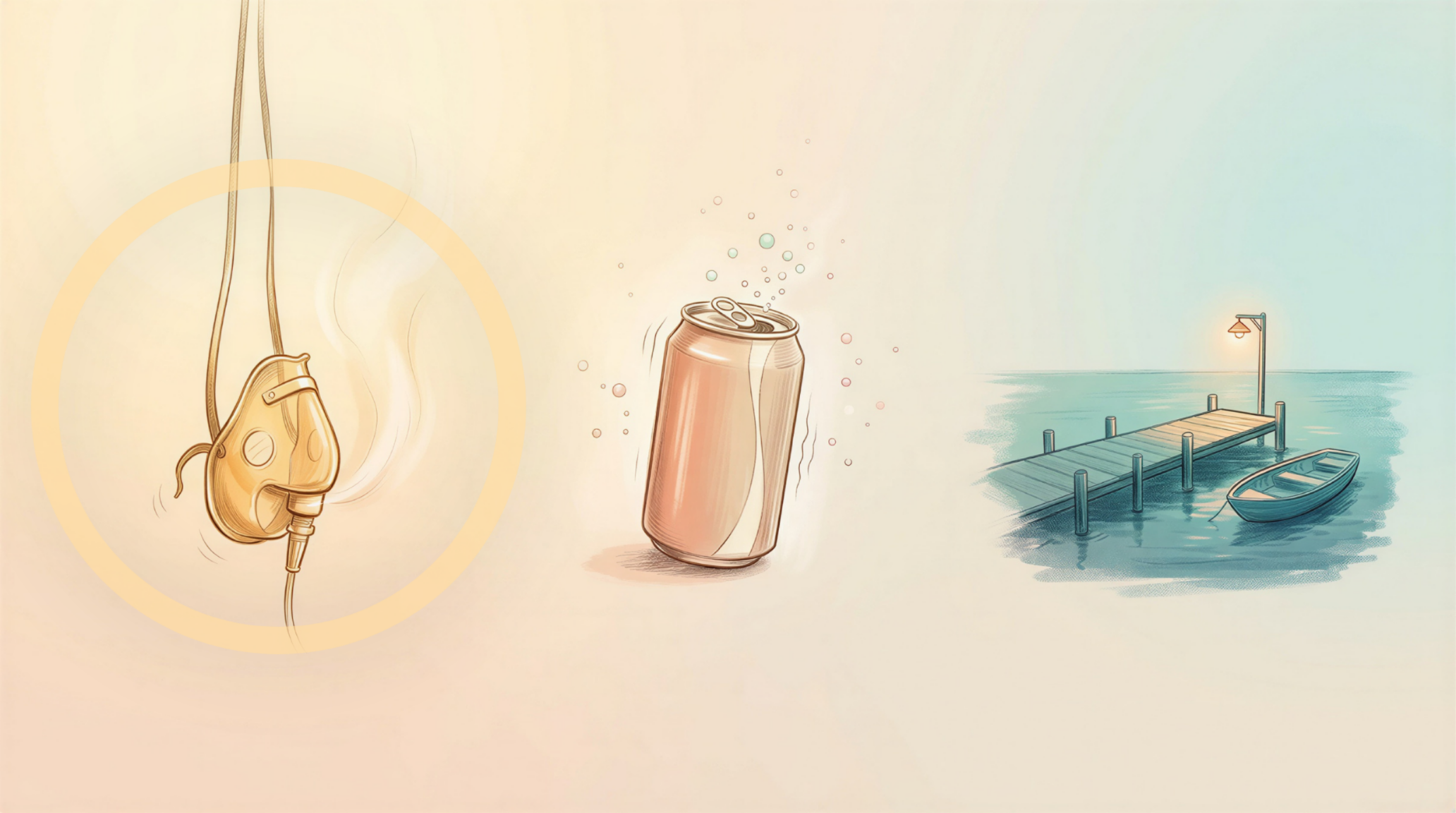
You know the safety briefing on an airplane. If the cabin loses pressure, oxygen drops down in front of you, and the instruction is always the same, and it always sounds a little wrong: secure your own oxygen first. Before your child’s. Everything in you rebels against it — surely you help the small person first. But the airline is not being cruel. It is being precise. A parent who has passed out helps no one. You get a handful of useful seconds, and the only way to spend them on your child is to still be conscious.
Parenting has its own version of that instruction, and it is just as counterintuitive: tend to yourself first — not instead of your child, but so that there is a you left to do the tending.
We tend to hear “take care of yourself” as either a luxury we cannot afford or one more thing we are failing at. It is neither. For a parent, it is the oxygen.
Your steadiness is what they borrow
There is a deeper reason to reach for your own oxygen first, and it is the part that turns self-care from selfish into structural.
A child in distress does not calm down by being told to. They borrow calm — from the most regulated nervous system near them, which is usually yours. When you can stay even a little steadier than the storm, your steadiness is not a nice extra. It is often the very thing they are reaching for — a calmer nervous system to borrow until their own comes back online.
Which means the care you give yourself — the sleep, the walk, the ten quiet minutes, the therapy hour — is not stolen from your child. It is deposited straight into the thing that helps most: a parent with something left in the tank.
It lands on you because you are the safe one
Hold onto this on the days it lands hardest.
When your child saves their biggest storms for you — when the yelling, or the slammed door, or the go away and leave me alone detonates at the person who has done nothing but try to help — it is easy to read that as proof you are getting it wrong. It is usually the opposite. Children come apart most completely in front of the person they are surest will stay. The storm lands on you because you are the safe place.
I sometimes say it to parents in six words: I’m sorry, and good job. Sorry, because being the safe place is genuinely exhausting and almost entirely invisible, and no one is clapping. Good job, because you built a safety solid enough to hold a storm. Both are true at once. The cost is real. So is what it means.
Repair, not perfection
On the nights you do lose it — because you will, everyone does — the standard was never perfection.
You do not have to respond flawlessly in the hard moment. That standard is not reachable, and chasing it is its own engine of burnout. What actually builds a child’s sense of safety is not a parent who never ruptures. It is a parent who comes back. The repair can be small, and late: yesterday was hard. That part wasn’t your fault. I’m working on it too.
And here is the part that turns your imperfection from a failing into the actual gift. Children do not learn resilience by watching a parent who never falters — there is nothing to learn from that, and no such parent exists. They learn it by watching you falter and come back: struggle, get it wrong, adjust, repair, apologize. Your recovery is the lesson. When you mend something you broke, you teach them — in the most durable way there is — that people who love each other rupture and repair. That may be the single most useful thing they carry into every relationship they will ever have. A parent performing perfection teaches none of it.
The grace you already give, turned around
Somewhere in here is a lens you have almost certainly already built, and only need to point in a new direction.
You have learned to look at your child’s hardest behavior with some grace — to see that they are not bad, they are overwhelmed; that they would do better in that moment if they could. That frame is true. It is also true of you. The psychologist Ross Greene put it simply: kids do well if they can. I would add the half he left out — and so do parents. You are not failing at this. You are a person doing well if you can, in a genuinely hard season, running on a nervous system as tired as you are. The compassion you pour out on your child all day was always meant to include the person pouring it.
Breathe first
None of this is a new checklist. You have enough of those. It is one reframe: your own care was never the thing you get to after everyone else is handled. It is the air you reach for first — not only so there is a you left to hold the rest, but because you are a person, and people need to breathe.
And you do not have to figure out the refilling alone. Reaching for support — naming that you are running low, and letting someone help you carry it — is not a failure of parenting first. It is parenting first. And it helps to have somewhere to be held, not fixed.
Breathe first. We will help with the rest.
Bridge Family Therapy offers neurodiversity-affirming, trauma-informed care in Athens, GA and across Georgia via telehealth. You can meet our team or reach us at (706) 352-9199.
Additional Reading
#2 - Contents Under Pressure — why your child’s biggest meltdowns have almost nothing to do with the thing that set them off.
#3 -You Are the Harbor, Not the Rescue Boat — what your job actually is when your child is struggling, and the one you can put down.
References
Feldman, R. (2007). Parent–infant synchrony and the construction of shared timing: Physiological precursors, developmental outcomes, and risk conditions. Journal of Child Psychology and Psychiatry, 48(3–4), 329–354.
Goodman, S. H., Rouse, M. H., Connell, A. M., Broth, M. R., Hall, C. M., & Heyward, D. (2011). Maternal depression and child psychopathology: A meta-analytic review. Clinical Child and Family Psychology Review, 14(1), 1–27.
Greene, R. W., & Winkler, J. (2019). Collaborative & Proactive Solutions (CPS): A review of research findings in families, schools, and treatment facilities. Clinical Child and Family Psychology Review, 22(4), 549–561.
Mikolajczak, M., Gross, J. J., Stinglhamber, F., Lindahl Norberg, A., & Roskam, I. (2020). Is parental burnout distinct from job burnout and depressive symptoms? Clinical Psychological Science, 8(4), 673–689.
Roskam, I., Brianda, M.-E., & Mikolajczak, M. (2018). A step forward in the conceptualization and measurement of parental burnout: The Parental Burnout Assessment (PBA). Frontiers in Psychology, 9, 758.
Tronick, E. Z., & Gianino, A. F. (1986). Interactive mismatch and repair: Challenges to the coping infant. Zero to Three, 6(3), 1–6.
Winnicott, D. W. (1971). Playing and reality. Tavistock. (Origin of the “good enough mother.”)