
Contents Under Pressure… Parenting Big Behavior
Why your child’s biggest meltdowns have almost nothing to do with the thing that set them off.
By Tyler Seabolt, LCSW | Bridge Family Therapy
It is almost never about the thing that set it off.
The meltdown arrives over something small — the wrong cup, a homework page, a request to put on shoes — and it is enormous, wildly out of proportion to the thing in front of you. Somewhere in the middle of it, you think: where did that come from? It came from a cup. It cannot possibly be about the cup.
It was not about the cup. The cup was just the pull-tab.
The shaken can
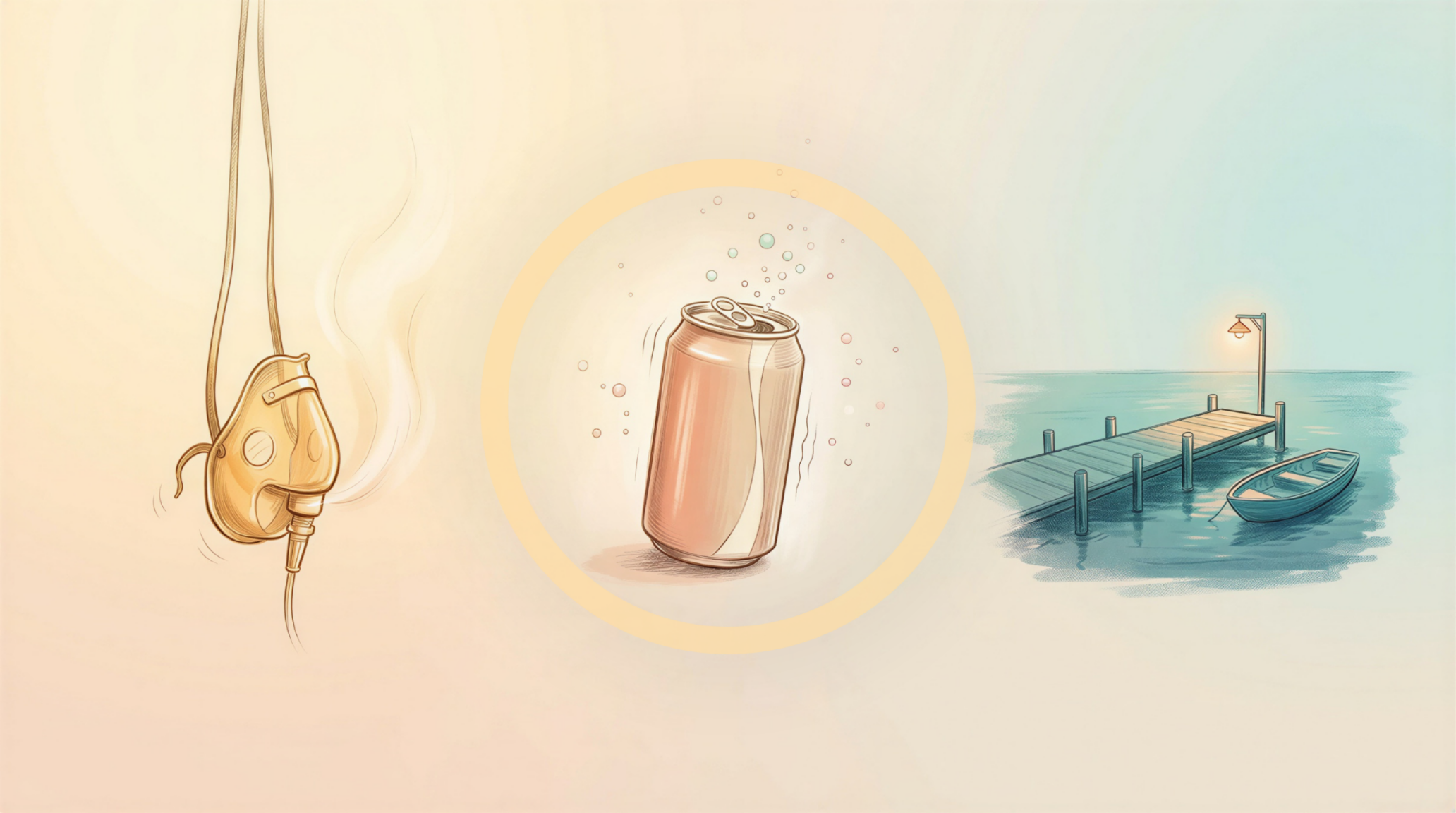
Picture a can of soda.
Every demand of an ordinary day gives it a shake. The loud hallway between classes. The tag scratching the back of a shirt. The effort of making eye contact and saying the expected thing. The transition from one activity to the next, and the next. The fluorescent hum, the group project, the hurry up, we’re late. None of these is a catastrophe. Each is one small shake.
For some kids, moving through modern life means being shaken all day long. And here is the trick of it: from the outside, the can looks completely calm. It sits on the shelf like any other. You cannot see the pressure building inside — until something opens it.
The eruption is physics
When the lid finally gives, what comes out is not misbehavior. It is pressure, doing exactly what pressure does.
A can that has been shaken all day cannot choose not to spray. There is a phrase I come back to with parents — kids do well if they can, from the psychologist Ross Greene — and it is never truer than here. In that moment, your child is not deciding to erupt. The capacity to hold it in is simply gone, spent hours ago. The eruption is not the problem -it is the release of a pressure that was already there. The cup was just the opening.
Why it’s calm at school and blows up at home
Which explains the thing that confuses parents most: why does my kid hold it together all day at school, and fall apart the second they walk in the door?
Because the lid holds where it is not safe to let go. All day — at school, in public, with people who have not earned it — your child keeps the lid clamped down: composed, managing, “fine.” That composure is exhausting, and it is not the same as calm. It is a lid straining against pressure. And a lid comes off where it is safe to come off.
So the eruption lands on you not because you did something wrong, but because you are the person your child trusts enough to fall apart in front of. It is a strange gift to receive, and it costs you a great deal to hold. Both of those things are true at once.
What’s shaking the can that you can’t see
The hard part is that most of the shaking is invisible to you.
You did not see the hours of holding it together. You did not feel the hallway, or the tag, or the low roar of a room that was a little too bright and a little too loud. Because that is the other piece: a child who takes in more of the world gets shaken harder by the parts of it the rest of us barely register. What looks like an overreaction is often an ordinary reaction to a much larger dose.
It is also why a child can seem so capable and so overwhelmed at the same time — the can can look perfectly composed and be one shake from bursting. Ability was never the question. Pressure was.
Don’t shake it more
Here is the part that is genuinely useful, and slightly counterintuitive.
When a can is about to go, the worst thing you can do is shake it more. And in the heat of the moment, a lot of ordinary parenting is another shake — the reasoning, the correcting, the “look at me,” the consequence, the raised voice. However well meant, each one is another jostle to a can already at its limit.
The move is to stop shaking it. Lower the demand. Dim the input. Give space and quiet, and let the pressure come down on its own — because a can left to settle can eventually be opened without the spray. This is not giving in, and it is not doing nothing. It is reading the physics. The teaching, the problem-solving, the “what could we try next time” — all of that works beautifully later, once the can has settled and the lid can come off gently. In the middle of the eruption, there is nothing to teach. There is only pressure to let out. It is the same thing you do for yourself, without thinking, when everything is too much — you let a breath out before you can take a better one in.
And when things are calm, you can get curious together — not “why did you do that,” but “that looked like a lot; what had the day been like?” You are learning to read the shakes you could not see.
Tolerance is variable, and it is shared
Two last things, because they take the pressure off.
First, tolerance is not a fixed setting. Each of us has a window of tolerance — a range inside which we can stay regulated and think clearly (Siegel, 1999). The window is wider on a good day and narrow on a bad one. You will tolerate being misunderstood far better after sleep and food than after a week without either. That is not a character flaw. That is a nervous system.
Second, in a close relationship, tolerance is shared. When one of you slides toward the edge of the window, the other feels the pull — nervous systems track each other, especially tethered ones. So when your partner has less to give in a hard moment, it often is not that they are misunderstanding you. It is that the whole system is running low. Less capacity is not the same as less care. And it moves — you are not static, and neither is the day.
Contents under pressure are to be expected
There is a warning printed on pressurized things: contents under pressure. It is usually followed by the word dangerous. I would change the ending.
Contents under pressure are to be expected.
Understanding the pressure is not the same as excusing the eruption — you cannot un-shake a can by scolding it, and you were never going to be able to. Your child is not a defective can. They are a can being shaken, all day, by a world that shakes hard — and doing a remarkable job of holding the lid on for as long as they do. Once you can see the pressure, the eruption stops looking like defiance and starts looking like what it is: physics, and information, and a nervous system asking for a little room.
Understanding your child means accounting for how much shaking their particular can takes — not measuring the spray against a can that was never shaken at all.
The next time it happens — and it will — see if you can find the shake behind the pull-tab. Not to excuse it. To understand it. That is the whole difference between managing a child and knowing one.
Bridge Family Therapy offers neurodiversity-affirming, trauma-informed care in Athens, GA and across Georgia via telehealth. You can meet our team or reach us at (706) 352-9199.
Additional Reading
#3 -You Are the Harbor, Not the Rescue Boat — what your job actually is when your child is struggling, and the one you can put down.
#1 - Parents First: Why Your Own Care Was Never Optional — on caregiver burnout, and why tending yourself is the work, not a break from it.
References
American Psychiatric Association. (2013). Diagnostic and statistical manual of mental disorders (5th ed.). (Hyper- and hypo-reactivity to sensory input as a diagnostic feature of autism.)
Ben-Sasson, A., Hen, L., Fluss, R., Cermak, S. A., Engel-Yeger, B., & Gal, E. (2009). A meta-analysis of sensory modulation symptoms in individuals with autism spectrum disorders. Journal of Autism and Developmental Disorders, 39(1), 1–11.
Greene, R. W., & Winkler, J. (2019). Collaborative & Proactive Solutions (CPS): A review of research findings in families, schools, and treatment facilities. Clinical Child and Family Psychology Review, 22(4), 549–561.
Myles, B. S., & Southwick, J. (2005). Asperger syndrome and difficult moments: Practical solutions for tantrums, rage, and meltdowns (2nd ed.). Autism Asperger Publishing. (The rumble → rage → recovery build-up model.)