You Are the Harbor, Not the Rescue Boat
Parenting Mental Health
When your child is struggling, the job you think you have — to fix it — was never actually yours.
By Tyler Seabolt, LCSW | Bridge Family Therapy
When you want to fix it
When your child is struggling — really struggling, the kind that keeps you up at night — something in you goes into rescue mode. You want to fix it. Find the thing, say the right words, get the right help, make the hurt stop. And underneath that is a fear so large most parents never say it out loud: what if I can’t?
Here is the first true thing: the helplessness you feel is not a sign you are failing. It is love with nowhere to put itself. The wanting-to-fix is the most natural thing in the world. It is also, it turns out, not the job.
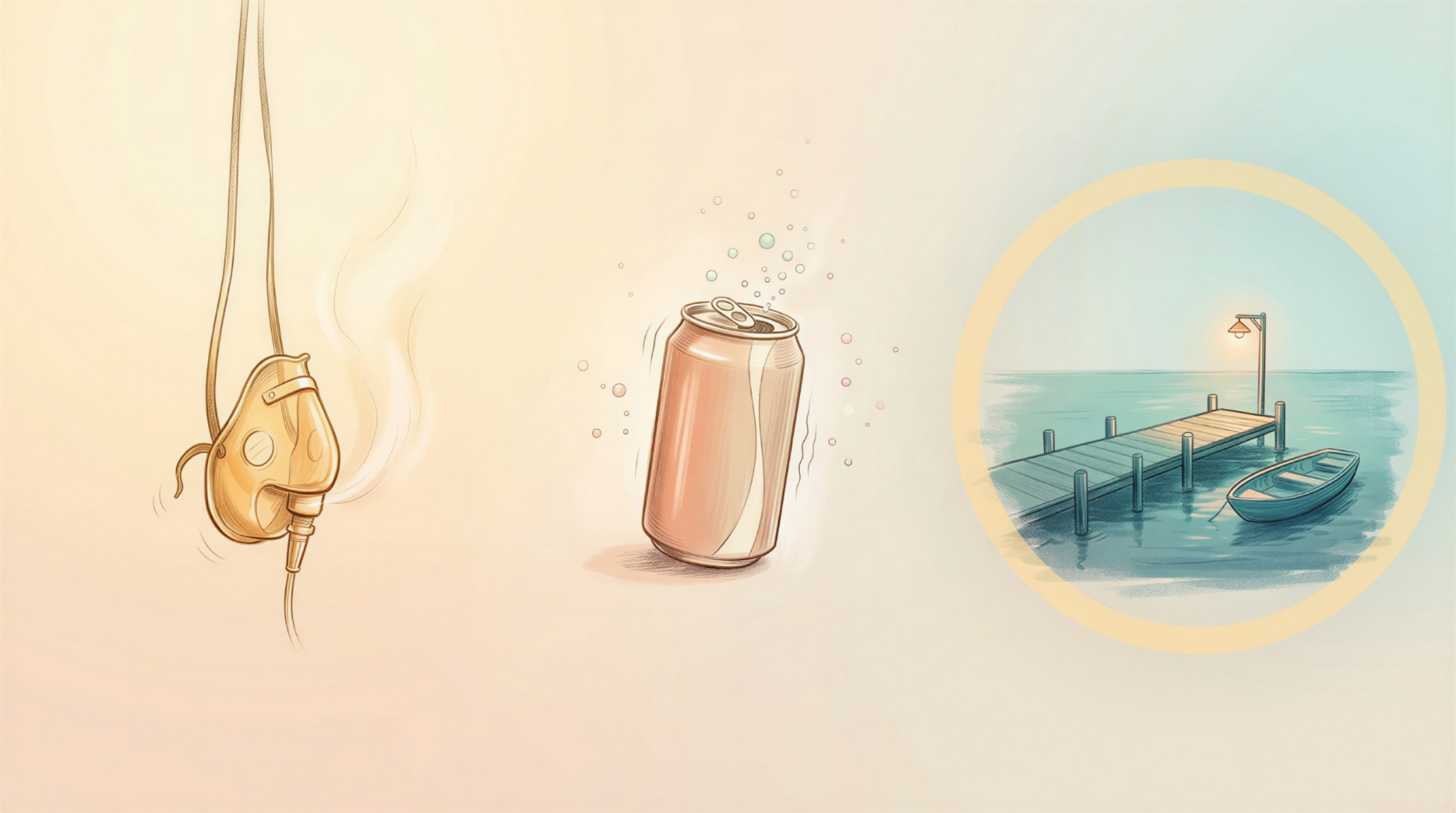
You are not the rescue boat
Somewhere along the way, most of us absorbed the idea that a good parent is a rescue boat — that when your child goes under, you are the one who pulls them out, solves it, makes it right. It is an exhausting thing to believe, because it is not possible, and when you inevitably cannot do it, the only conclusion left is that you have failed at the thing that matters most.
You are not your child’s rescue boat. You are not their therapist, their psychiatrist, or their cure, and you were never meant to be. Let that be a relief, not a loss. That job was never yours — and it is not the one that helps most anyway.
You are the harbor
Here is the job that is actually yours, and it is quieter and more powerful than rescuing.
You are the harbor.
A harbor does not chase the ship out into the storm. It does not fix the weather. It is the fixed, safe place the ship can come back to — to stop, to be still, to be repaired, to be met. When the sea is bad, the harbor does not need to do anything dramatic. It needs to be there, and steady, and safe to return to. That steadiness — your non-fixing, non-panicking presence — is not a lesser thing than fixing. It is the ground the fixing is built on.
And notice: a harbor is not judged by whether the storms come; storms come. It is judged by whether there is somewhere safe to wait one out. Your child’s struggle is not evidence that your harbor failed — it is the weather. The harbor is simply what you offer against it.
Why it collapses right now
Being the harbor asks something specific of you, and it is not what you would expect. It does not ask you to have the right words, or the solution, or a plan. It asks you to stay — to receive whatever your child brings you without rushing to fix it. When they hand you something dark — a fear, a despair, a thought that scares you both — the most helpful thing is often not to solve it, but to stay in the water with them while it passes.
And let me be honest about what that does not mean, because “be the calm one” is the kind of advice that quietly asks you to be superhuman. It does not mean you feel nothing. It does not mean you never get rattled — you will, because you love them, and a parent who felt nothing here would not be steady, only absent. Your child does not need you unshakeable. They need you to be shaken and stay. “That scares me too, and I am not going anywhere” offers more safety than any performance of calm. Being human in front of them, and not leaving, is the steadiness.
There is one more thing this advice usually misses, because it pictures a child who comes to you and talks. Often they do not. Often the first sign is the opposite of talking: the usually chatty kid goes quiet, or the already-quiet kid goes nearly silent. They hold on to it. They do not bring their ship to the dock — they anchor out in the dark, just past where you can reach. You cannot drag a ship into harbor, and trying — the interrogation, the just tell me what’s wrong — tends to send it further out. What the harbor does instead is notice the change from their ordinary weather, keep the light on, keep the water calm, and make coming in feel safe rather than examined. You stay reachable, and you let them know, in a hundred small unpushy ways, that the harbor is open whenever they are ready.
Which, in the end, means listening more than you counsel — and being a safe place to say the thing, or to sit in the quiet beside you until saying it becomes possible.
A lot of it is downstream
It helps to know where much of the struggle comes from, because it is rarely where it looks like it is.
A great deal of what gets called a child’s “mental health struggle” is downstream — the accumulated cost of holding it together all day, of masking, of moving through a world built for a different kind of nervous system, of being misread and unaccommodated. The anxiety, the shutdown, the flatness are often not the disease. They are the bill for everything else. Which means part of harboring is easing the upstream load — being a place they are understood, lowering the demands where you can — not only weathering the downstream storm.
When it looks like they are holding on to it
One more thing, because it frightens parents and is almost always misread.
Sometimes a struggling kid seems to identify with their struggle — to wear it, to talk about it constantly, to resist the very help you are offering. It can look like they want to be unwell, and that reading can make a scared parent angry. It is almost never true. More often, in that struggle — or among the people who share it — your child has found the first place they felt genuinely understood. You cannot argue someone out of the only room where they have felt seen. But you can become another such room. The harbor does not talk them out of their pain. It becomes a place they feel understood enough that they no longer have to hold on to it so tightly.
One dock is not the whole harbor
Now I want to take something back — or really, to widen it.
A moment ago I told you that you are the harbor. That is true, and it is too small. A harbor is not a single dock. It is a whole protected stretch of water with many places a ship can safely tie up. You are one — the home berth, the one they always know is there. But part of your job is making sure there are others: other helping professionals, trusted friends, community organizations, prosocial peers, mentors and coaches — and, at the far end when the danger is real, crisis resources and lines — several of which are gathered at the end of this piece.
Because here is what the anthropologists and family-systems researchers have long observed, and what parents almost never get told: you were never supposed to be able to do this alone. For nearly all of human history, children were raised by many hands — grandparents, aunts and uncles, older siblings, neighbors, the whole community. There is a name for it: anthropologists call it cooperative breeding — the recognition that our kind evolved to raise children with many hands, not two. A child held by many people is not a sentimental ideal. It is closer to the original arrangement.
The recent research — including a 2024 U.S. Surgeon General advisory devoted entirely to the pressures on today’s parents — names this isolation as a real and widespread strain, and finds that the informal supports parents once leaned on have thinned, until more and more of the weight lands on one or two people, often a parent alone in a house. That is a historical aberration, not a personal failing. You are not exhausted because you are weak or doing it wrong. You are exhausted because you are attempting, by yourself, something the species was never built to do solo.
And there is one more honest thing to name, because you are probably already thinking it: many of those docks are not free. When the village came apart, the help that grandparents and neighbors once gave for nothing did not vanish — a great deal of it moved behind a price. The therapist, the OT, the tutor, the specialized camp are, in part, the paid replacements for hands that used to be freely given. That is not a small thing, and it is not your imagination — the cost is a real barrier, and for many families a real grief. If you cannot reach a dock because of what it costs, that is a failure of the system, not of your love. And it is exactly why the docks that stay freely open — a mentor, a prosocial peer, a community or faith group, a library program, a sliding-scale service, a crisis line — matter more now, not less.
The point
You cannot fix your child’s inner weather. You were never supposed to be able to. What you can be is one safe place among others — a dock they always know is there.
But a dock is only a safe place to tie up if it is kept in good repair — and that means tending your own. You cannot hold your child steady from a dock whose own moorings are quietly rotting, with no one helping you keep them up. So tending yourself is not a break from the work. It is the work.
And here is the deeper reason, the one that matters most. Your child learns to seek safe harbor by watching you do it — not once, but again and again. They will not reach for support as they grow, will not quite believe it is allowed, if they have never watched the people they love most reach for it out loud when the water got high. When you tend your own dock, admit you cannot do it alone, and go looking for your own harbor, you are not failing to be strong for them. You are teaching them, by living it, the most important thing there is: that seeking harbor is simply what people do.
Because the truth under all of it is bigger than parenting. It takes a village to raise a child. It takes a village to hold up the ones doing the raising. And in a world built the way this one is, it takes a village just to be a person. You were never meant to be a harbor unto yourself.
If you have read this far, we hope it has landed less like a light thrown on everything in disrepair, and more like one sturdy new board laid into your dock. And that you read it at all says something worth naming: you are already the lamp lit at the end of the dock in low visibility — already reaching for the support you cannot entirely provide, and were never meant to.
So whatever you decide about us, that door stays open here. Whether or not Bridge turns out to be your fit, we are committed — always — to answering the email and the call, and pointing you toward other docks in the harbor we trust. You do not have to become a client to be met. You only have to reach out.
Bridge Family Therapy is in Athens, GA, offering neurodiversity-affirming, trauma-informed care across Georgia via telehealth. You can meet our team or reach us at (706) 352-9199 — whether or not we turn out to be your fit.
Mental Health Resources - Other docks in the harbor
You were not meant to hold all of this alone. These are some of the other places to tie up — ones we know and trust. Reach for whichever fits.
If you or your child is in crisis, right now -
988 Suicide & Crisis Lifeline — call or text 988, any hour, free and confidential.
Crisis Text Line — if talking feels like too much, text HOME to 741741.
Georgia Crisis & Access Line (GCAL) — Georgia’s own 24/7 line, 1-800-715-4225; they can talk it through or send a mobile team.
The Trevor Project (for LGBTQ+ young people) — call 1-866-488-7386 or text START to 678-678.
Veterans Crisis Line — dial 988, then press 1, or text 838255.
In immediate physical danger, call 911. Athens has 24/7 emergency rooms at Piedmont Athens Regional (1199 Prince Ave) and St. Mary’s (1230 Baxter St).
When it is not an emergency, but you need a way in -
SAMHSA National Helpline — 1-800-662-4357, free and confidential, helps you find care nearby (English or Spanish).
Advantage Behavioral Health Systems — Athens’s community behavioral-health provider: therapy, youth programs, and a 24/7 crisis center right here in town. 240 Mitchell Bridge Rd · (706) 389-6767 / (855) 333-9544.
NAMI HelpLine — not a crisis line, but a warm place to ask “where do I even start?” 1-800-950-6264 (Mon–Fri).
For neurodivergence, disability, and the family around it -
Parent to Parent of Georgia — pairs you with parents who have walked the road ahead. 1-800-229-2038 · p2pga.org.
Extra Special People (ESP) — a Watkinsville nonprofit where kids of all abilities and their families get to just belong. (706) 769-9333 · espyouandme.org.
Babies Can’t Wait — Georgia’s free early-intervention program for little ones birth to three. 1-888-651-8224.
For you, the parent-
Postpartum Support International — support for the tender early months, when your own mind needs care too. Call or text 1-800-944-4773.
National Maternal Mental Health Hotline — free, confidential help for pregnant and new parents, day or night. 1-833-852-6262.
NAMI Family Support Group & Family-to-Family — free peer support and classes for families loving someone through a mental-health condition; find one through NAMI Georgia · namiga.org.
Everyday places to belong -
Athens-Clarke County Library — free story times, programs, and a quiet corner that is here whenever you need it. athenslibrary.org.
Boys & Girls Clubs of Athens — after-school and summer programs across Athens where kids find mentors and a place to land. (706) 546-5910.
Athens YMCA — sports, camps, and youth programs. 915 Hawthorne Ave · athensymca.org.
Additional Reading
#1 - Parents First: Why Your Own Care Was Never Optional — on caregiver burnout, and why tending yourself is the work, not a break from it.
#2 -Contents Under Pressure — why your child’s biggest meltdowns have almost nothing to do with the thing that set them off.
References
Ainsworth, M. D. S., Blehar, M. C., Waters, E., & Wall, S. (1978). Patterns of attachment: A psychological study of the strange situation. Lawrence Erlbaum. (The “secure base.”)
Bowlby, J. (1988). A secure base: Parent-child attachment and healthy human development. Basic Books.
Hrdy, S. B. (2009). Mothers and others: The evolutionary origins of mutual understanding. Harvard University Press. (Cooperative breeding / alloparenting — the pattern of shared care; the stronger causal claim about human cognition is a live debate and is not asserted here.)
Putnam, R. D. (2000). Bowling alone: The collapse and revival of American community. Simon & Schuster. (Texture on social-capital decline.)
U.S. Surgeon General. (2024). Parents under pressure: The U.S. Surgeon General’s advisory on the mental health & well-being of parents. U.S. Department of Health and Human Services.