
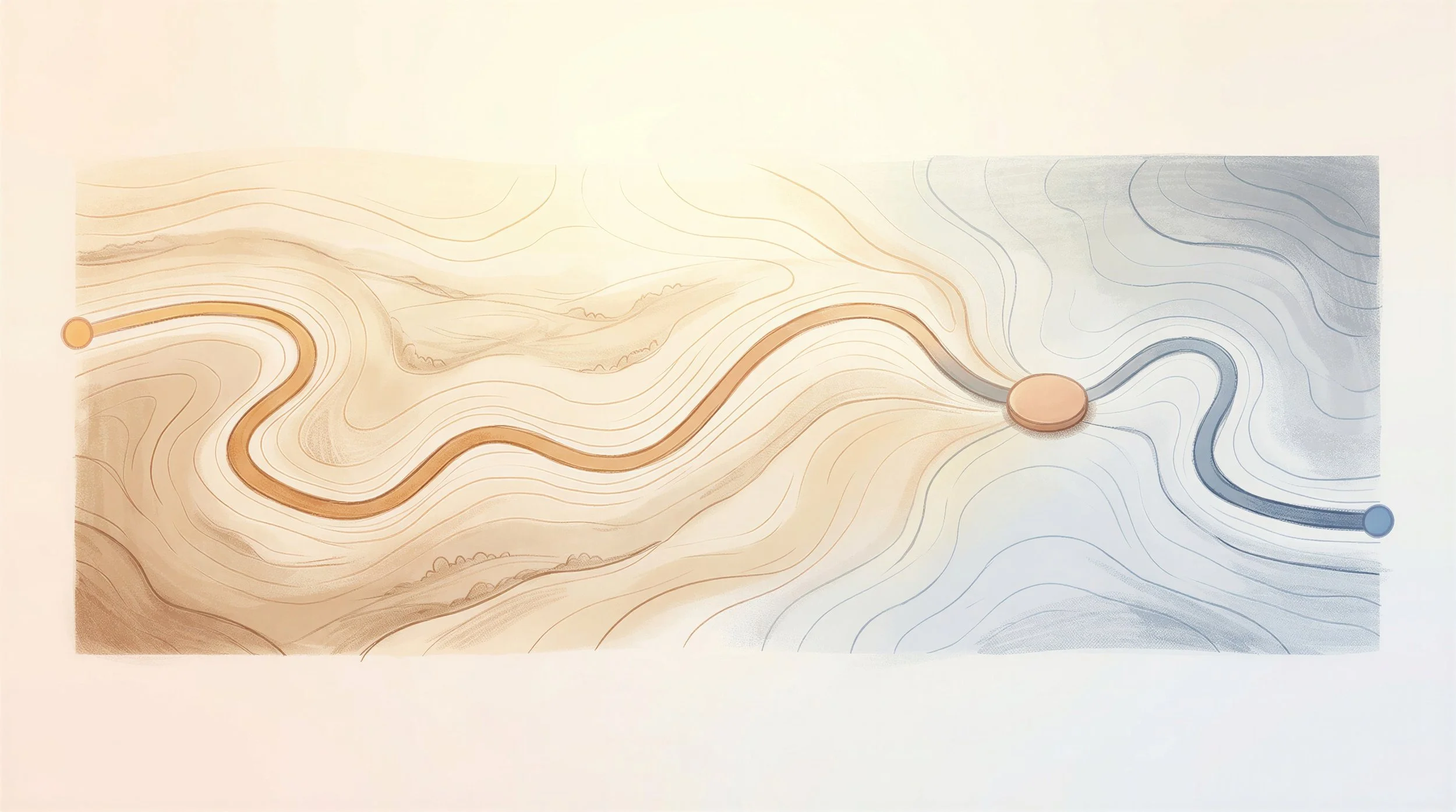
Meet Me a Quarter of the Way
On being misread across the gap between different minds — and what actually helps.
By Tyler Seabolt, LCSW | Bridge Family Therapy
There is being understood, and there is being read right — and they are not the same thing.
Most of us can, with effort, make ourselves understood. We can explain, and re-explain, and find the words. Being read right is different. It is the sense that another person takes in who you are — your tone, your intent, the shape of you — and gets it, without a fight.
If your mind works differently from most of the people around you, you may know a particular version of this. You do everything right. You are kind, clear, careful. And you still get misread. Not because of what you said — because of how you came across, in the first few seconds, before you had said anything that mattered.
A quick note on who this is for. The research I lean on was mostly done with autistic people, because that is where it has been studied most closely. But the gap this piece is about is wider than the studies. The lived experience of it — being misread across the space between your nervous system and the room’s — runs across neurodivergence, whether you were born with it or life’s traumas rewired you later, though its shape differs from person to person. As you will see near the end, it also rhymes with what many misread and marginalized people have long known. Where I say “autistic,” read it as the case that has been measured, not the edge of the idea.
It is the space between, not you
Here is something the research has gotten much clearer about lately, and it is worth saying plainly.
When autistic people talk with other autistic people, something eases. Rapport comes more readily; the conversation flows. The same holds for non-autistic people together. The friction shows up in the mix — when two different neurotypes try to read each other across the gap (Crompton et al., 2020).
Read that again, because it matters. The difficulty is not inside the autistic person. It lives in the space between two different kinds of minds, and it runs both directions. The autistic scholar Damian Milton named this the double empathy problem: not one person failing to understand a “normal” one, but two people, wired differently, each straining to read the other (Milton, 2012).
That reframe takes something off your shoulders. You are not a broken communicator. You are one half of a hard translation.
A difference you often cannot see
There is something particular about many neurodivergent differences: much of the time, no one can see them. A nervous system that works differently often does not announce itself the way some differences do — though for plenty of people it does show, and many carry a visible difference and an invisible one at once. When it is the hidden kind, it becomes visible only when it is weighed against a local convention — how much eye contact is “right,” how much small talk is “warm,” what counts as “too much” or “too flat.”
And those conventions are not laws of nature. They are set by the dominant culture of a particular place and time — by geography, by custom, by who happens to hold the norm. Cross a border, change the room, change the decade, and the same nervous system reads differently. What is “odd” in one place is unremarkable in another.
So the difference was never in you alone. It surfaces at the moment your way of being meets a yardstick you did not choose — and most of the time, until it meets that yardstick, there may be nothing to see at all.
Style, not substance
It gets more specific, and more freeing.
When people meet an autistic or a neurodivergent person, they form an impression fast — within seconds. Those first impressions are often unkind: less approachable, more awkward, someone to keep at a distance. It happens quickly, it does not soften with more exposure, and it makes people less willing to engage (Sasson et al., 2017).
But here is the part worth carrying around with you. In the same research, when people were given only a transcript — the words, stripped of the voice and the face — the negative bias all but disappeared. The judgments were about style, not substance. The ideas were fine. The packaging got misread.
Sit with that. If you have been left feeling that something is wrong with what you think, or what you have to offer, the evidence says otherwise. What gets misread is the delivery — the rhythm, the eye contact, the tone — not the content. That is a very different, and much more workable, problem.
Meet me a quarter of the way
So whose job is it to close the gap?
The honest answer, the one that stings, is that it mostly ends up landing on you. If your nervous system is the minority one in the room, you are the one who learns to translate — to read the unwritten rules, to smooth your delivery, to carry the difference so other people do not have to. This is not a character flaw, and it is not a courtesy. It is labor, and it has a cost.
If you have a strong sense of fairness — and a lot of neurodivergent people do — this can feel like a genuine injustice. It is asymmetrical. By any fair accounting, the person doing less of the translating would come further to meet you. There is a plain name for why they often don’t: privilege is not having to. When the world is already shaped to your nervous system, closing the gap is optional — someone else’s effort, someone else’s problem. That optionality, treated as the natural order of things, is what ableism is made of. I am not going to pretend otherwise.
And — both things can be true — in the actual world, you will often still carry more of it. Not because that is right, but because you are frequently the one who can see the gap in the first place. So here is the reframe I offer. The phrasing is mine — not a finding I can hand you a citation for. The instinct underneath it is not mine at all, and I will come to whose it is.
The goal is not “meet me halfway.” It is “meet me a quarter of the way.”
Halfway assumes an even split of a job that was never even. A quarter is honest about the asymmetry — you are already doing most of the work — while still asking the other person for something. And a quarter turns out to be a lot. When the other person comes even part of the way — learns a little about how you work, extends some benefit of the doubt — the whole interaction changes.
Whose map this is
I have been writing as if this skill — reading the room, smoothing your delivery, deciding when to explain yourself — were a neurodivergent invention. It is not. Almost none of it is. The map I have been handing you was drawn, over generations, by people who learned it long before anyone thought to study autistic communication. It is worth stopping to say whose map this is.
The closest kin is family, not metaphor. The idea that the trouble lives in the fit between a person and a world — not inside the person — did not start with neurodiversity. It came from disabled activists, who built what is now called the social model of disability and insisted that a wheelchair user is disabled by the stairs, not by their legs (Oliver, 1983). Their rallying cry — nothing about us without us — is the ground the whole neurodiversity movement stands on. Even the double empathy idea that opened this piece was first published in a disability-studies journal (Milton, 2012). When you locate your difficulty in the gap instead of in yourself, you are using a tool disabled people built.
From queer communities comes the hard math of disclosure. Long before “do I tell them I’m autistic or ADHD or neurodivergent” there was “do I let them know who I love” — the same careful, costly weighing of when it is safe to be seen. Erving Goffman named the difference between a stigma that shows and one you can hide, and called the managing of the hidden kind passing (Goffman, 1963). Queer people also taught something the affirming world can forget: concealment is not always weakness. Sometimes the closet is survival, and choosing when to stay in it is its own wisdom. The disclosure tool in this piece is theirs before it is ours.
The very language for the inner cost is borrowed, too. Minority stress — the chronic load of being the different one in the room, and the way the world’s read of you can get swallowed and turned into “something is wrong with me” — was built to explain what lesbian, gay, and bisexual people carry (Meyer, 2003). Its disability-world name is internalized ableism: the majority’s verdict on you, taken inside until it feels like the truth about you (Campbell, 2009). This is the shadow of where we began — it is the space between, not you. Internalized ableism is what happens when the space between gets folded inward. Researchers have only recently begun to trace this in autistic people, and the early evidence points somewhere kind: what tracks with distress is the stigma and the loneliness, not being autistic itself (Botha & Frost, 2020; van Asselt et al., 2026). If you live with rejection-sensitive dysphoria, you may know its sharpest edge — the wound landing before the words do. The way I would connect it: RSD is that bracing-for-rejection turned all the way up and felt in the body. And the labor of arranging your face for someone else’s comfort has a name of its own — emotional labor — first mapped by studying women at work (Hochschild, 1983).
The oldest and most-mapped version — the one to name last and hold most carefully — belongs to Black and colonized people.Code-switching was theirs first: the daily, skilled shift between how you speak at home and how you must speak to be heard, and to be safe, in a white institution. I am not going to tell you that is the same as smoothing an autistic delivery. It is not, and the difference matters. But I do not have to reach for the comparison myself — autistic researchers have already drawn it, carefully, naming W. E. B. Du Bois and Frantz Fanon as they went (Pearson & Rose, 2021; Radulski, 2022). We are joining a conversation these communities began. We are not borrowing their pain.
One more thing, because it is easy to miss. I have been saying “them” and “us,” as if neurodivergent people were one group and these communities another. Many of us are both — Black and autistic, queer and ADHD, disabled more than once over — living every one of these at the same time, no metaphor required. For them it was never a comparison. It was Tuesday. The people at those intersections did not inherit the map. They have been drawing it all along.
So here is the gratitude, plainly. We did not invent this. We inherited a set of tools — the insight that the trouble lives in the fit, the disclosure calculus, the words for the inner cost — from people who are still, right now, using them to move through a world that was not built for them. The least we can do is know whose they are, and say thank you.
Tolerance is variable, and it is shared
Two last things, because they take the pressure off.
First, tolerance is not a fixed setting. Each of us has a window of tolerance — a range inside which we can stay regulated and think clearly (Siegel, 1999). The window is wider on a good day and narrow on a bad one. You will tolerate being misunderstood far better after sleep and food than after a week without either. That is not a character flaw. That is a nervous system.
Second, in a close relationship, tolerance is shared. When one of you slides toward the edge of the window, the other feels the pull — nervous systems track each other, especially tethered ones. So when your partner has less to give in a hard moment, it often is not that they are misunderstanding you. It is that the whole system is running low. Less capacity is not the same as less care. And it moves — you are not static, and neither is the day.
The tool: tell people how you work
The most practical of those inherited tools is also the simplest. Here is the move that does the most, for the least.
Instead of masking harder — performing “normal” until you are worn through — you offer a small, contained piece of yourself, and invite the other person to meet it. Something like: “Let me tell you what helps us work best together.” Then a sentence or two. I do better with direct questions. I might need a beat before I answer. I’m not being cold — that’s just my face at rest.
This is not oversharing, and it is not a diagnosis speech. It is a short, deliberate note that says here is how to read me, offered on your terms.
And it works, on average. When people know a little about how a neurodivergent person communicates — sometimes even just the fact of it, even a single sentence — their impressions tend to warm, and the same behavior often reads more generously (Sasson & Morrison, 2019). In one study (a mock job interview), simply knowing the candidate was autistic lifted the interviewer’s ratings across every dimension measured; the label alone was enough (Norris et al., 2024). Telling people how to read you measurably changes how they read you.
But I want to be honest, because the research is honest. This is a real tool, not a magic one. Most of those encouraging results come from controlled studies. In everyday life it is more mixed — some people carry stigma, and with them, disclosure can backfire (Thompson-Hodgetts et al., 2020). Which is exactly why this stays your call. You read the room and decide: is this a person, or a moment, worth the offer? You control the timing, the content, and how much of yourself you put on the table. Disclosure is a tool you get to use — never one you owe anyone.
Two kinds of masking
Which brings up masking, and a distinction I lean on. The research has its own version — what gets called adaptive versus maladaptive camouflaging — but I find it lands better with two plainer names.
Most of what has been written about masking — the constant editing of yourself to seem acceptable — is about its cost, and that cost is real. Years of it wear people down. But I do not think the answer is “never mask.” I think two different things wear the same name.
There is compelled masking — the compulsive kind, running all the time, the only shield you have. It never switches off, and it was never really chosen; the pressure to do it does the choosing. That is the one that burns you out.
And there is constructive masking — deliberate, time-limited, and as chosen as anything under that pressure can be. The fifteen seconds of smoothing it takes to leave a conversation that is going nowhere. The bit of polish for a stranger you will deal with once, because the deeper offer is not worth it here. This kind is a tool, not a cage. The difference is not how much you mask. It is whether you had any say in it, and whether you can put it back down.
The goal is not to stop masking. It is to move what you can from the first kind toward the second — from a reflex that runs you toward a tool you pick up on purpose and set down when you are done. Some of it will not move; the pressure is real, and it is not your fault. This is about the part that can.
Play scientist with your own interactions
If you read the companion piece to this one, you have met this move already: step back from the moment and watch it, like a scientist studying a reaction rather than being the reaction.
Here it does a specific job. It lets you runthe math before you spend the energy. Not every interaction is worth the full translation. Some people, some moments, are worth the real offer — let me tell you how I work. Others just need a light touch and an exit. A stranger behind a counter is not the place to explain your nervous system; a person you are going to build something with might be.
The skill is not “always translate” or “never mask.” It is choosing where your translation energy goes — spending it on the relationships that will carry it, and going light everywhere else. That is not cynical. It is sustainable.
The point
You cannot make people read you right. That is not on offer, and chasing it — trying to be so clear, so smooth, so palatable that no one could possibly misread you — turns into its own exhausting mask.
What you can do is smaller, and more durable. You can name how you work, on your terms, to the people worth naming it to. You can ask for a quarter of the way, and let the people who come meet you tell you who they are. And you can spend your energy where it is returned. What you have to offer was never the problem.
And you do not do any of this alone, or from scratch. The tools are borrowed — the way of seeing the gap, the disclosure calculus, the language for the cost — carried to you by people who needed them first, and who are still using them now. You are the newest to learn a very old skill, in very old company.
The gap between different minds is real. It does not close by you becoming someone else. It narrows, a little, each time you offer a door — and someone chooses to walk through it.
If this resonates and you are looking for support, Bridge Family Therapy offers neurodiversity-affirming, trauma-informed therapy in Athens, GA and across Georgia via telehealth. You canmeet our team and schedule a consultation.
References
Botha, M., & Frost, D. M. (2020). Extending the minority stress model to understand mental health problems experienced by the autistic population. Society and Mental Health, 10(1), 20–34.
Campbell, F. K. (2009). Contours of ableism: The production of disability and abledness. Palgrave Macmillan.
Crompton, C. J., Ropar, D., Evans-Williams, C. V. M., Flynn, E. G., & Fletcher-Watson, S. (2020). Autistic peer-to-peer information transfer is highly effective. Autism, 24(7), 1704–1712.
Crompton, C. J., Sharp, M., Axbey, H., Fletcher-Watson, S., Flynn, E. G., & Ropar, D. (2020). Neurotype-matching, but not being autistic, influences self and observer ratings of interpersonal rapport. Frontiers in Psychology, 11, 586171.
Goffman, E. (1963). Stigma: Notes on the management of spoiled identity. Prentice-Hall.
Hochschild, A. R. (1983). The managed heart: Commercialization of human feeling. University of California Press.
Meyer, I. H. (2003). Prejudice, social stress, and mental health in lesbian, gay, and bisexual populations: Conceptual issues and research evidence. Psychological Bulletin, 129(5), 674–697.
Milton, D. E. M. (2012). On the ontological status of autism: The ‘double empathy problem’. Disability & Society, 27(6), 883–887.
Norris, J. E., Prosser, R., Remington, A., Crane, L., & Maras, K. (2024). Disclosing an autism diagnosis improves ratings of candidate performance in employment interviews. Autism, 28(4), 1045–1050. https://doi.org/10.1177/13623613231203739
Oliver, M. (1983). Social work with disabled people. Macmillan.
Pearson, A., & Rose, K. (2021). A conceptual analysis of autistic masking: Understanding the narrative of stigma and the illusion of choice. Autism in Adulthood, 3(1), 52–60.
Radulski, E. M. (2022). Conceptualising autistic masking, camouflaging, and neurotypical privilege: Towards a minority group model of neurodiversity. Human Development, 66(2), 113–127.
Sasson, N. J., Faso, D. J., Nugent, J., Lovell, S., Kennedy, D. P., & Grossman, R. B. (2017). Neurotypical peers are less willing to interact with those with autism based on thin slice judgments. Scientific Reports, 7, 40700.
Sasson, N. J., & Morrison, K. E. (2019). First impressions of adults with autism improve with diagnostic disclosure and increased autism knowledge of peers. Autism, 23(1), 50–59.
Thompson-Hodgetts, S., Labonte, C., Mazumder, R., & Phelan, S. (2020). Helpful or harmful? A scoping review of perceptions and outcomes of autism diagnostic disclosure to others. Research in Autism Spectrum Disorders, 77, 101598.
van Asselt, L., Roke, Y., Begeer, S., & Scheeren, A. M. (2026). Extending the minority stress model of autism: Internalized stigma and loneliness as predictors of stress and life satisfaction. Autism. Advance online publication. https://doi.org/10.1177/13623613261446876